
Introduction
Today I’m bringing you the disassembly, teardown, and analysis of a vintage Nokia d-box Multimedia Terminal (DVB) — a relic from the early days of digital broadcasting. This receiver teardown will reveal the inside of this classic device.
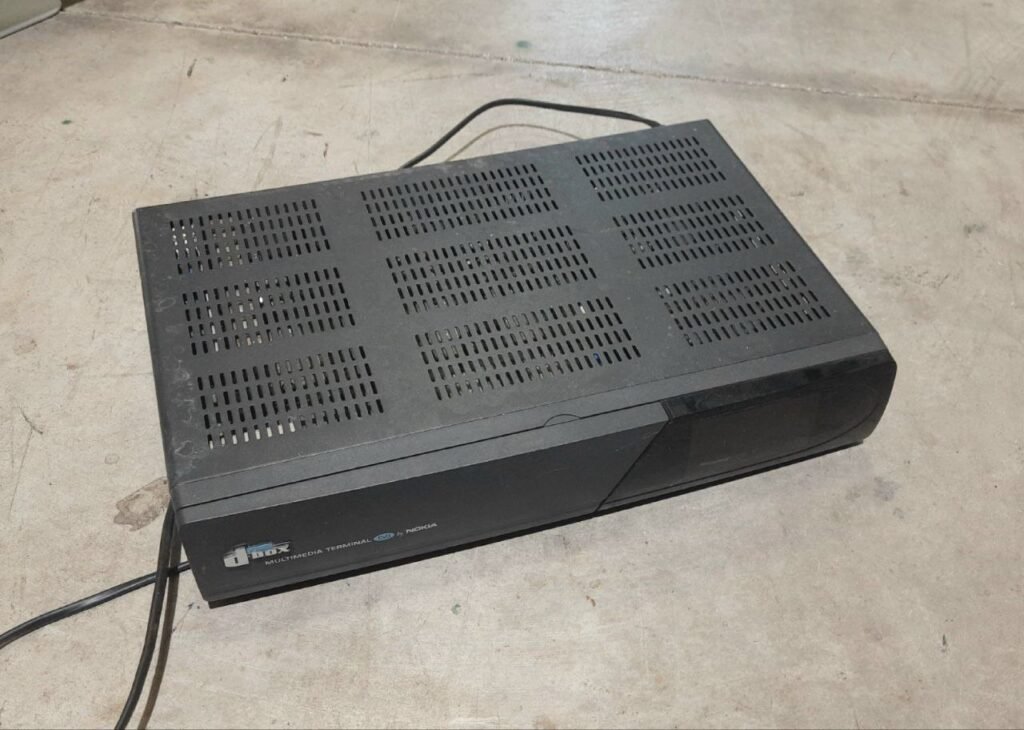
Background
Back in the day, these pay-per-view terminals were everywhere. Satellite and cable TV were at their peak, and streaming platforms like Netflix or Disney+ didn’t even exist yet. If you wanted premium content, you needed one of these boxes — often provided by your cable company — and a subscription card.
Teardown
Since this was high end stuff at the moment, i thought that it would probably house some interesting electronic components.
When I first tried to open the unit, I noticed it used security Torx screws on the top cover. I didn’t have the right bit at the moment, so I took it home to try again.
Later, I realized it wasn’t Torx at all — it was some kind of pentalobe security screw, the kind you rarely see outside of Apple devices. My iFixit kit didn’t include that bit either, so I had to resort to an extraordinary method to remove the cover. Let’s just say it wasn’t elegant, but it worked.
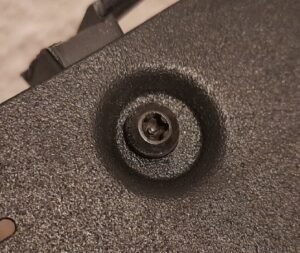
Security screw found in the Nokia d-box satellite receiver
The Nokia d-box DV3 is surprisingly well-built for a consumer-grade multimedia terminal. It features a plastic bottom shell where the main PCB is mounted, a metal top cover, a separate front panel, and a metal shield on the rear. Inside, there’s also a metal internal frame that adds rigidity and structural integrity once the unit is fully assembled.
To disassemble it, you’ll need a special pentalobe security screwdriver — not something you’ll find in a standard toolkit. Using unusual fasteners was common at the time, and many satellite and cable receivers of the era used similar anti‑tamper measures. Manufacturers weren’t only trying to discourage casual repairs; they were also responding to a growing wave of hardware experimentation. In the analog pay‑TV scene, for example, researchers often used popular video‑processing chips to analyze scrambled signals and study how the image was segmented or manipulated. With this kind of tinkering becoming widespread, especially in pay‑per‑view systems, adding physical barriers like security screws was one of the simplest ways to protect the internals and limit unauthorized access to premium content.
Main Board and Architecture
Let’s get into detail! What I was excited about those vintage receivers of the late 90’s is that they were very expensive so probably they would have a lot of electronic components is to see what kind of integrated circuits inside, memories, microcontrollers, maybe even an FPGA?
The receiver features a single main board with all elements integrated on it (Power Supply, receiver and modem), except the control panel display, which is a commercial unit from Hyundai.
Power supply
The Nokia d-box DV3 uses a switching power supply that’s built directly into the main board rather than being handled by a separate PSU module. The 220 V AC mains feed enters straight onto the PCB, where the high‑voltage section takes care of converting alternating current into the various DC rails required by the digital electronics. Even though it’s part of the same board, the power-supply area is clearly isolated with wide clearance zones, silkscreen warning symbols, and dedicated component spacing — all intentional design choices meant to keep technicians from accidentally touching the high‑voltage section while the unit is powered.
One of the key components is the L4940D2T5, a 5V linear voltage regulator. It supplies power to the digital logic circuitry, but it’s likely that other parts — such as the display, modem, or RF receiver — require additional voltages.
Interestingly, I couldn’t locate a dedicated PWM controller IC, which is unusual. A switching power supply typically relies on a PWM chip to regulate voltage efficiently. It’s possible that the PWM functionality is embedded in another component or handled by a custom ASIC, but it’s definitely something worth investigating further.
Satellite Receiver
A separate, self‑contained tuner module, connected to the main board via a multi‑pin header. The entire unit is enclosed in a metal RF shield, both to reduce electromagnetic interference and to prevent stray signals from affecting the sensitive front‑end circuitry. This shielding also keeps the tuner’s local oscillators and intermediate‑frequency stages from radiating noise into the rest of the system, ensuring stable reception and compliance with regulatory emission limits.
Modem
Strangely, the receiver has a modem module, based in the chip
Main Board
The mainboard is marked 5511985-03A in the copper and 55 11985-03 with silkscreen both in top and bottom sides,
PCB Technology
The main board is a 4 layer stack with standard 1,6mm thickness, as usual. It features mostly SMD components, having components on both sides of the board. Components placed in the bottom (solder side) were soldered by solder wave (not selective) the smaller components being 0805 packaging (fortunately).
[explicacion de como se hacia]
The manufacturing process is: Pick and place places all of the components in the top after solder paste using a stencil, after that IR reflow ovens, that attach the components to the top side of the board. After reflow process has been completed, pick and place to components in the bottom, which are attached to the substrate by means of adhesive (red loctite), then it is flipped and the Thru Hole components are inserted and the bottom components and THT components are soldered in a solder wave.
The first time I knew I was surprised that SMD components can be soldered by wave, but yes, indeed they are, although care has to be taken in the design and soldered components have to be placed in certain direction (sometimes using solder thief pads)
Display
The display is manufactured by Hyundai, marked as HT12538-D on the PCB and HT12538FB-LYPF-04, which is likely an assembly or batch number. I haven’t seen the display working yet, since I haven’t powered up the receiver. However, it appears to be an LCD dot matrix display. Searching those part numbers only returns results related to the d-box itself, which suggests that the display was manufactured specifically for this device.

Close picture of the display. Source
 English
  Español